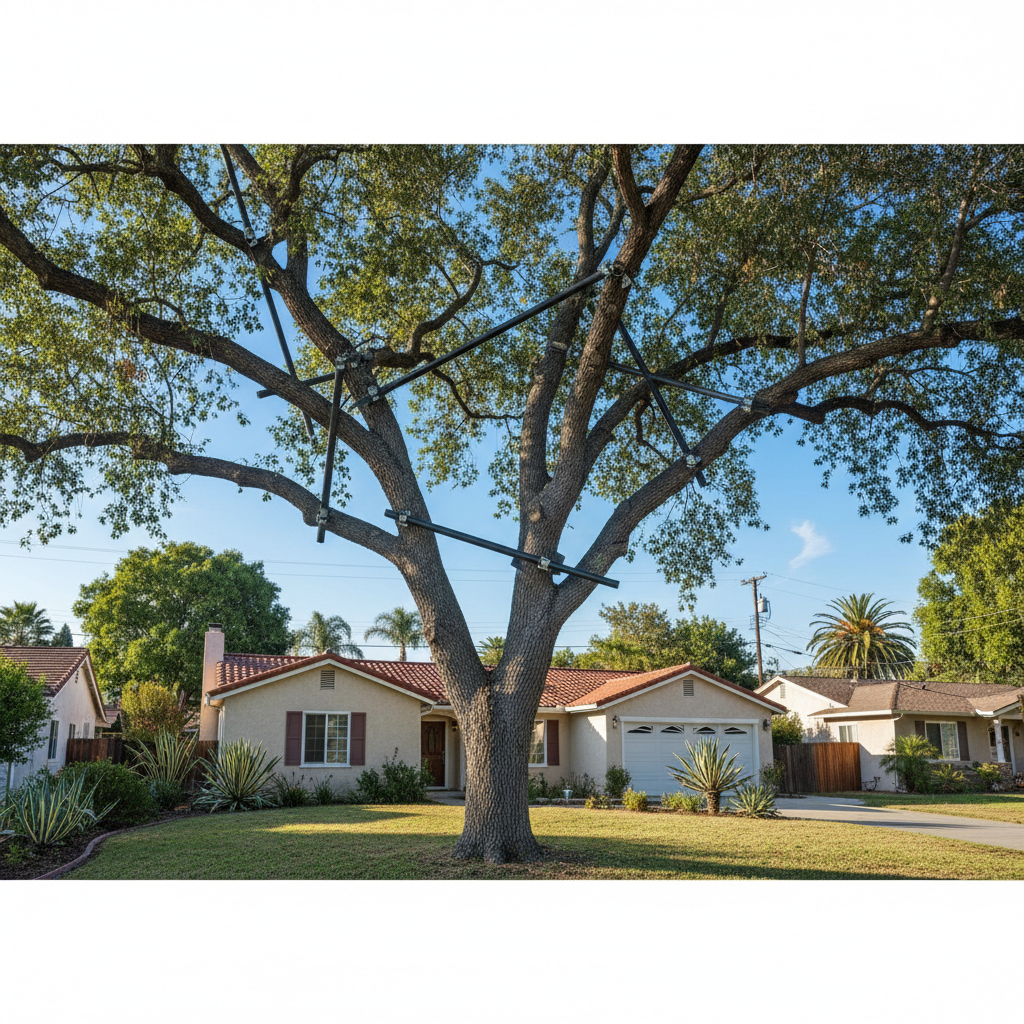
You ever look at one of those grand old trees in your yard, maybe a big Ficus or a mature Eucalyptus, and wonder if it's really as sturdy as it looks? Especially after a strong Santa Ana wind whips through, or we get one of those rare but heavy winter rains? That's when I start thinking about tree cabling and bracing, and you should too.
It's not about cutting down a tree that's perfectly healthy, but about giving it a bit of extra support where it needs it most. Think of it like putting a brace on a wobbly fence post, but for something much bigger and more alive.
What's the Deal with Cabling and Bracing?
Alright, let's break it down. Cabling involves installing high-strength steel cables between major limbs to limit their movement relative to each other. It's usually done high up in the canopy. This helps reduce the stress on weak crotches or unions that might be prone to splitting. Bracing, on the other hand, uses steel rods inserted through weak or cracked limbs or trunks to provide more rigid support. Sometimes we do both, depending on what the tree needs.
The goal isn't to make the tree completely rigid. Trees need to sway a bit in the wind; that's how they build strength. But if you've got a tree with a V-shaped union that's already showing signs of weakness, or a limb that's grown out over your house and looks like it's about to give, these techniques can literally save the tree and prevent some serious damage to your property.
Why Inglewood Trees Need This
We've got some unique challenges here in Inglewood. For one, a lot of our older neighborhoods, especially those charming streets near Edward Vincent Jr. Park, have mature trees that were planted decades ago. These trees are beautiful, they provide amazing shade, but they've also grown up with certain structural issues. Maybe they were pruned poorly when they were young, or they've just naturally developed weak points over time.
Then there's our weather. We don't get hurricanes, but those Santa Ana winds can be brutal. They put immense stress on tree limbs, especially those with a heavy canopy. And while rain is usually welcome, a sudden heavy downpour can add significant weight to leaves and branches, exacerbating any existing weaknesses. I've seen plenty of mature Ficus trees, common in many Inglewood yards, develop significant cracks in their main trunks or large limbs. Their dense canopies catch a lot of wind, and their wood can be prone to splitting.
Another factor is our soil. A lot of Inglewood sits on a mix of sandy loams and heavier clays. While generally good, if a tree's root system isn't perfectly established or has been compromised, the entire tree can become less stable, making structural issues in the canopy even more critical.
When Do I Recommend Cabling or Bracing?
You might be wondering if your tree needs this. Here are some common situations where I'd suggest we take a closer look:
- Weak V-shaped crotches: These are notorious for splitting, especially in trees like Liquidambars or some Oak varieties.
- Codominant stems: When a tree has two or more main trunks of similar size growing from the same point, they can compete and create a weak union.
- Excessively long or heavy limbs: If a limb extends far out and has a lot of foliage, it puts a lot of leverage on its attachment point.
- Cracks or splits in limbs or the trunk: If you see these, don't ignore them. They're a clear sign of structural failure.
- Included bark: This is when bark grows inward between two merging stems instead of forming a strong union. It's a recipe for future splits.
- Recent storm damage: If a tree lost a limb in a storm, the remaining structure might be compromised and need support.
It's not a DIY job, folks. This kind of work requires specialized knowledge, specific hardware, and the right techniques to ensure it's effective and doesn't harm the tree in the long run. You need to know where to place the cables, how much tension to apply, and what kind of hardware will last in our Southern California climate without girdling the tree or failing.
Why Local Expertise Matters
When you're dealing with something as important as the safety and health of your trees, and potentially your home, you want someone who knows our local conditions. Someone who's seen how our specific tree species react to our winds and our soil. That's where a local company like Oasis Tree comes in. We're not just some out-of-town crew passing through; we live and work right here in Inglewood.
We understand the common issues with the trees in our neighborhoods, from the mature Sycamores lining the streets to the fruit trees in your backyard. We can assess your tree's specific needs, recommend the best course of action, and install cabling or bracing systems that are designed to last and keep your tree healthy and safe for years to come. Don't wait until a limb comes down; get it checked out.